Natural
Reference propagation and loss for ordinary rooms, chambers and halls.
 PRODUCT GUIDESLegal notices
PROPAGATION / DIFFUSION / MEMORY
Place a sound inside an evolving acoustic field.
Build familiar ambience or deeper source-driven environments from one connected field. Reflections travel, scatter, interact and ultimately fade; geometry and prior excitation influence the next phrase.
Init is a restrained reverb, not dry. Raise Mix temporarily to learn the field. A missing Driver does not disable ordinary reverb.
START HERE / ABOUT 90 SECONDS
Use drums, plucked keys or a vocal phrase with gaps. Insert Space and choose Init.
Scale 35% · Density 50% · Topology 35% · Depth 20% · Decay 2.5 s · Material 0% · Memory 25% · Evolution 25% · Flow 0% · Coupling 25% · Perspective 50% · Character Natural · Drive 0% · Mix 25% · Output 0 dB · Pre-delay 20 ms
0 of 4 steps checked — reading progress only.
The source inhabits a fading acoustic environment. Depth changes placement, not simply wet level; long Decay does not make an infinite Freeze.
Choose Plate for a more connected surface-like response or Porous for softer permeability. Compare Characters with the same phrase, not just their first instant.
LEARNING ILLUSTRATION — NOT CONNECTED TO YOUR PLUGIN
A qualitative explanation at a fixed Mix, not an acoustic simulation or connection to your plugin.
Near the surface, the source feels more in front of the environment.Intermediate Depth embeds excitation further into the connected paths.Higher Depth places the source more deeply inside the field. Mix still independently determines dry/wet balance.A qualitative explanation, not a calculated response or audio preview. Use the plugin to hear the result.
PARAMETER REFERENCE
Scale, Density, Topology and Depth describe the environment. Decay governs energy loss; Memory and Evolution describe what happens as that environment is used.
Characteristic propagation dimensions and travel times, not literal metres or simply reverb length. Small favors tight paths; large longer journeys.
Try this: Compare 25% and 55% with Decay fixed.
Scattering complexity and overlap. Low can reveal discrete paths; high diffuses them, with deep settings approaching smear.
Try this: Try 35% versus 70% on short attacks.
Connectivity of alternate/revisiting pathways, not a feedback amount. A connected field can still be short if Decay is short.
Try this: Compare 25% and 65% across a repeated phrase with gaps.
Where the source enters the environment: near the surface versus more immersed. It is distinct from Mix and conventional Pre-delay.
Try this: At fixed Mix, compare 15% and 60%.
Nominal energy-loss/reverb time. Geometry, Character and the evolving field affect the audible tail, so this is not an exact RT60 promise for every setting. Even maximum is ultimately lossy.
Try this: Compare 1 s and 4 s while holding Scale fixed.
Soft/selectively absorptive through Neutral to harder reflection relationships. It can affect loss, definition and scattering, not only a high-frequency damping shelf.
Try this: Compare±25% on a tail with clear upper detail.
How strongly prior excitation temporarily conditions the field encountered by later sound. It remembers being excited; it is not how long acoustic energy itself remains.
Try this: Raise toward 60% and compare isolated versus repeated phrases.
How strongly energy changes state as it ages through propagation, scattering, diffusion and residue. It is not a second Decay.
Try this: Try 50% on a long-enough tail to hear its development.
Amount of source-driven currents and their inertia. Motion emerges from the energized field, not a free-running chorus LFO or host-synced rate.
Try this: Try 25% after hearing a static field, then compare repeated excitation.
Reciprocal relationship between source excitation and the occupied environment. It is not a send level, transient knob or diffusion amount.
Try this: Compare 20% and 60% while keeping Depth and Mix fixed.
How the listener perceives separation among pathways and late structures. Lower is more convergent/frontal; higher reveals more spatial separation. It does not move the source's Depth.
Try this: Compare 30% and 70% on stereo output and check mono.
Six laws within one field alter propagation, permeability, connectivity, timing or spectral geometry. Switching preserves the populated environment rather than clearing the tail.
Try this: Compare Natural, Plate and Bloom on the same short phrase.
Contribution of an optional external sidechain Driver to field structure. Driver audio is never directly mixed in. Without a connected bus it is retained but unavailable and contributes zero external structure.
Try this: Route a rhythmic sidechain in the DAW before raising Drive; keep Main audio present.
Blend of source and acoustic field. Init 25% is restrained; higher values help you learn the environment. It does not move the excitation point like Depth.
Try this: Try 60% while learning, then return toward 25% in context.
Final gain trim after blending, without replacing the field's loss behavior. It does not change Decay.
Try this: Match levels after changing Mix or deeper geometry.
Conventional delay before acoustic excitation, including true zero. Independent of Depth and host compensation latency; it is not a synced note selector.
Try this: Compare 0 ms and 25 ms to separate the attack from the field.
CHARACTER REFERENCE
Reference propagation and loss for ordinary rooms, chambers and halls.
Connected surface-like dispersive propagation for plate/metallic-chamber territory.
Lossy boundary penetration and related re-emergence, from soft ambience toward foggy smear.
Sparse/nonlocal pathways, isolated returns and negative space rather than inevitable density.
Surviving energy opens into later broader structures without reversing audio or creating new energy.
Frequency-dependent propagation within one coupled field, not pitch shifting or unrelated band reverbs.
KNOW YOUR INSTRUMENT
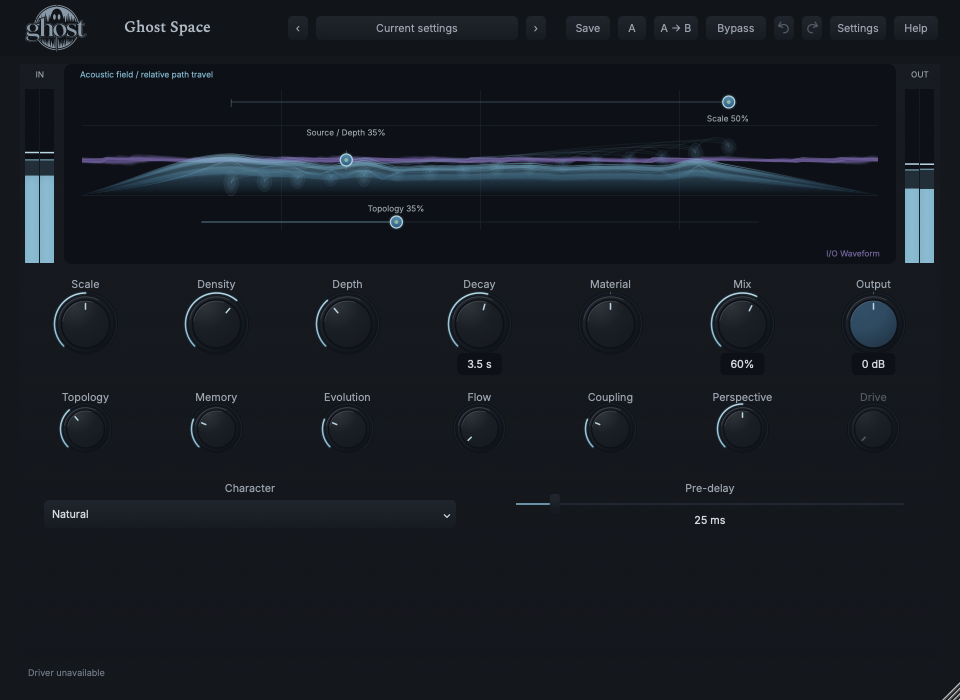
Light-blue propagation energy and violet recent I/O waveform context share one display. The field is a qualitative view of actual paths, travel and occupancy, not a literal architectural room drawing.
Choose a marker, or use the complete keyboard-accessible control reference above.
Scale's extent bracket, Depth's source handle and Topology's connectivity handle edit their named controls. Network links reflect measured strength and energy, not just a decorative higher setting.
Drag the named handles; Shift/Option gives fine/extra-fine control. Tab, arrows, Enter, Home and Escape provide equivalent selection, adjustment, exact entry, reset and cancel.
Driver unavailable is an honest routing status, not a failed reverb. Purple waveform time/amplitude differs from acoustic-path geometry. Closing/reducing motion changes visual work only.
HEAR THE IDEA
Actual Natural Space at Scale 50%, Density 65%, Depth 35%, Decay 3.5 s, Mix 60% and Pre-delay 25 ms. The original source stops at 3.1 seconds so the remaining acoustic tail is exposed; the finite example ends with a disclosed short file fade.
Source
Source WAVProcessed · actual Ghost DSP
Processed WAV{"scale": 50, "density": 65, "depth": 35, "decay": 3.5, "mix": 60, "pre-delay": 25}. Actual native processor, stereo48k/127/double; source latency-aligned. Whole-file wet RMS gain 1.768059; common trim 1.0. Identical final20ms file fade; no listening approval inferred.
Reproduction recordUse a dry drum or vocal phrase with gaps.
Scale 20% · Density 55% · Decay 0.8 s · Depth 15% · Mix 25% · Pre-delay 15 ms
Listen for: A restrained acoustic setting rather than an exposed long echo.
Use repeated keys or guitar phrases separated by silence.
Character Bloom · Scale 60% · Decay 6 s · Memory 60% · Evolution 55% · Flow 25% · Mix 50%
Listen for: A later-opening, history-conditioned field, not reversed source audio or an indefinite freeze.
GO DEEPER
Route an optional mono/stereo DAW sidechain while Main supplies the audible material. Raise Drive to let that rhythm/structure condition the field. Driver alone cannot make Main silence generate an acoustic sound, and unavailable Drive does not secretly use Main instead. This is not conventional wet ducking.
Decay governs remaining energy; Memory governs how prior excitation changes later field response. Evolution governs aging, Flow its source-driven motion. Full sessions/A/B retain the populated field and conditioning; portable presets retain the recipe without an old live tail.
All fifteen continuous controls support internal modulation and MIDI CC learn; Character is discrete host automation only. There is no note-trigger instrument, user Seed or Free/Sync rate.
Mono, stereo and causal mono-to-stereo propagation are supported. The optional external Driver transfers structure, never audible sidechain audio. Perspective is not a conventional Side-gain widener.
Computational latency is zero; propagation and Pre-delay are intentional musical timing. Normal bypass stops new excitation while the field drains. Hard bypass/Panic clears energy without resetting ordinary settings. Maximum Decay is not indefinite suspension.
The preset browser offers All, Factory, User and Favorites, category/search filters and relevant Character filtering. A row's heart changes your personal favorites without loading or saving the sound. Save As creates a distinct User sound; explicit Save updates only the selected User sound. Factory content is protected. Name, category and tags support organization; deleting a User category keeps its presets as Uncategorized. Manage supports rename, duplicate, confirmed delete and individual/bulk/category import/export. Personal favorites stay on this installation rather than travelling in exported sounds.
Standalone and the matching Ghost Rack module share the same User sounds, categories and favorites. A module preset changes portable sound settings, not Rack placement, Rack wet/dry, bypass or modulation assignments. DAW recall embeds the sound settings and does not depend on a preset file remaining on disk. Rack chain presets are a different library and affect the whole chain.
Drag a knob normally, hold Shift for fine adjustment or Option for extra-fine. Double-click restores its default. Enter/context menus provide exact values, reset and value copy/paste; eligible controls also offer MIDI Learn and modulation. Tab and arrow keys provide keyboard access. A/B compares configurations; the adjacent copy button copies the active configuration to the other. Undo/Redo groups a continuous gesture into one edit. Settings provides UI scale, Reduced Motion, source configuration, portable settings and Panic. UI size/motion preferences do not change the sound.
WHEN SOMETHING ISN’T CLEAR
It requires a routed external sidechain Driver. Without one its saved value is retained but contributes nothing. Main audio still produces normal reverb.
Init Mix 25% is restrained. Raise Mix temporarily, use a phrase with gaps and compare Scale/Decay before judging it.
It changes connections and routes through the field. Compare over several events/tail development at a useful wet level, not just the first transient.
No. The field is ultimately lossy and does not pitch-shift. Spectral Freeze owns indefinite suspension; pitch transformation belongs to pitch processors.