Prism
Precise coherent refraction and articulate spectral families.
 PRODUCT GUIDESLegal notices
REFRACT / REPRODUCE / REMEMBER
Let different parts of a sound find different places in time.
Begin with musical echoes, then refract spectral families into living memory that can move, diffuse, inherit and return. One bounded memory engine spans micro-time resonance, beat-scale delay and longer phrases.
Free stores a physical time; Sync follows host BPM. Both retain their own selections. Factory sounds contain a recipe, not someone else's captured memory.
START HERE / ABOUT 90 SECONDS
Use short guitar, vocal or keys phrases with gaps. Insert Spectral Delay and choose Init.
Time 500 ms · Dispersion 0% · Feedback 30% · Flow 0% · Gravity 15% · Diffusion 0% · Flux 0% · Character Prism · Mix 35% · Output 0 dB · Timing Free · Time 1/4
0 of 4 steps checked — reading progress only.
At neutral geometry it reads as delay; Dispersion reveals spectral identity distributed through time rather than a separate effect inserted around an echo.
Add one of Flow, Diffusion or Flux at a time. Time changes act on existing memory, so judge its settling as well as its first response.
LEARNING ILLUSTRATION — NOT CONNECTED TO YOUR PLUGIN
Qualitative memory explanation, not a simulation or connection to your processor.
Low Diffusion preserves more individually recognizable memory events.Intermediate values connect generations into streams while their relationships remain relevant.High Diffusion makes more shared spectral matter. Lowering it can condense new discrete structures from surviving history.A qualitative explanation, not a calculated response or audio preview. Use the plugin to hear the result.
PARAMETER REFERENCE
Featured Time sets memory scale. Dispersion separates identity through time; Feedback reproduces it; Flow, Gravity, Diffusion and Flux change what that history becomes.
Continuous logarithmic memory scale in Free, from micro-time resonance to long phrases. Existing generations rescale rather than being cleared. In Sync its modulation offsets the tempo-derived base in octaves; stored Free Time remains separate.
Try this: Begin at 500 ms, then try 375 ms in Free before expressive moves.
Signed temporal refraction among related spectral structures, not simply a high-frequency/low-frequency delay curve. Crossing zero converges and unfolds relationships in the opposite topology.
Try this: Compare 0%, +30% and -30% on a phrase with attacks and sustain.
How deeply memory reproduces into generations. Zero gives one traversal; high values permit persistent bounded history, not unrestricted gain or unlimited ancestry.
Try this: Start at 30% and increase gradually while monitoring gaps.
History's temporal current: positive moves deeper downstream, negative returns toward the present, zero anchors relationships. No memory can play before its causal source.
Try this: Compare±25% after several generations exist.
Positive favors source-derived harmonic/rhythmic relationships; negative seeks alternatives. It is not a hard pitch or delay-time quantizer and has no Key/Scale selector.
Try this: Compare +30% and -30% with moderate Dispersion.
Individual events toward connected streams and shared spectral matter. Reducing it lets discrete structures condense from surviving field state, not necessarily the exact original objects.
Try this: Raise toward 50%, wait, then lower and hear what emerges.
How freely stressed generations reinterpret inherited identity. Zero favors faithful inheritance; returning to zero stabilizes successful changed lineages rather than resetting them.
Try this: Try 25% after the basic memory is established.
Six laws govern spectral memory, not unrelated inserted effects. Changes retain generations, ancestry and current field state.
Try this: Compare Prism and Tape first; then Liquid with active Flow/Diffusion.
Blend of aligned dry source and processed memory. Default 35% keeps original context. It is separate from Feedback's survival and Diffusion's state of matter.
Try this: Raise temporarily to 60% to learn the field, then fit the song.
Final level after blending. It does not empty memory or reduce Feedback's generational depth.
Try this: Trim before comparing deeper or sustained Factory examples.
Free retains its saved milliseconds independently of later BPM changes. Sync derives duration from the saved division and current host BPM even while stopped; missing/invalid tempo falls back to 120 BPM.
Try this: Choose Sync for tempo-following echoes; switching mode does not automatically open the division picker.
Twenty-one straight/dotted/triplet choices from 1/1 to 1/64, active in Sync. The featured knob steps deterministically; clicking its musical readout opens the compact 7×3 direct picker.
Try this: At 120 BPM compare 1/8=250 ms, dotted 1/8=375 ms and triplet 1/8≈166.7 ms.
CHARACTER REFERENCE
Precise coherent refraction and articulate spectral families.
Generations age and imperfectly inherit, without claiming a named tape-machine emulation.
Shared spectral matter stretches, shears and flows through currents.
Time/relationship stress cracks and reorganizes related histories.
Compressed ancestry and contextual similarity influence recurrence.
Sparse generations and extinction make negative temporal space part of the memory.
KNOW YOUR INSTRUMENT
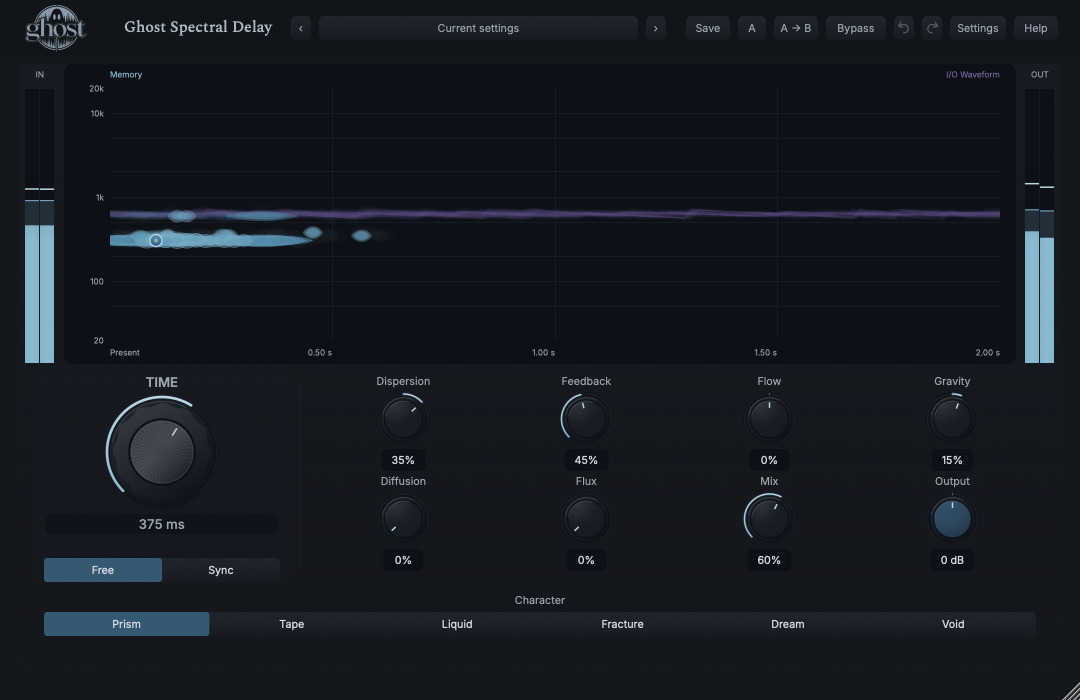
Blue memory structures show frequency vertically and temporal distance from the present horizontally. Purple I/O waveform context shares the same graph with a separate recent-time/amplitude meaning.
Choose a marker, or use the complete keyboard-accessible control reference above.
The present boundary is on the left; the labelled horizon adapts to Time/history. Glyph size is qualitative identity, not an exact duration. Only prominent descendants get foreground objects.
Drag/throw a memory to alter real position/momentum. Shift-drag pushes histories together; Shift-Option pulls apart. Empty-field drag creates a wake only when existing matter is available.
Left/right selects, Up/Down throws, Shift-Right pushes, Shift-Option-Right pulls and Space wakes; Escape cancels. In Sync the value picker supports arrow navigation, Enter/Space selection and Escape/outside dismissal, restoring focus.
HEAR THE IDEA
Actual Prism Spectral Delay in Free 375 ms, Dispersion 35%, Feedback 45%, Gravity 15% and Mix 60%. Source stops at 3.2 seconds to expose its descendants. This finite file is not a demonstration of unlimited memory.
Source
Source WAVProcessed · actual Ghost DSP
Processed WAV{"timing-mode": 0, "time": 375, "dispersion": 35, "feedback": 45, "gravity": 15, "mix": 60}. Actual native processor, stereo48k/127/double; source latency-aligned. Whole-file wet RMS gain 1.262424; common trim 1.0. Identical final20ms file fade; no listening approval inferred.
Reproduction recordUse a running DAW and short vocal or guitar phrases.
Timing Sync · Time 1/8 dotted · Dispersion 0% · Feedback 30% · Mix 35%
Listen for: Tempo-following base timing, with existing spectral physics still able to shape descendants.
Use repeated pitched phrases followed by gaps.
Character Liquid · Time 700 ms · Dispersion 40% · Feedback 60% · Flow -25% · Diffusion 55% · Mix 55%
Listen for: Source-derived history changing state, not a raw audio loop or conventional reverb.
GO DEEPER
Free's fresh quarter-note initialization happens once; later BPM never rewrites stored Free Time. Sync follows current valid BPM, including stopped transport. Independent Free Time/division recall is preserved. Time modulation offsets the synchronized base in octaves without disconnecting it from tempo.
Full DAW sessions, A/B and Undo retain living memory, transitions and ancestry. Portable sounds/Copy Settings contain settings only and develop fresh memory from input. High Feedback can persist, but bounded resources mean it is not an unlimited recorder or arbitrary sample archive.
Nine continuous controls support internal modulation and MIDI CC learn. Character, Timing and Note Division use discrete host automation only. There is no direct external audio sidechain, MIDI-note instrument or per-tap editor.
Framing latency is reported and every dry/Rack blend is aligned. Intentional memory Time is a musical effect separate from that latency. Stereo identity follows source and memory relationships.
Normal bypass stops new feed while history finishes; hard bypass/Panic clears it safely without choosing Init. No separate reverse/freeze switch, quantizer, FFT controls or sample browser is provided.
The preset browser offers All, Factory, User and Favorites, category/search filters and relevant Character filtering. A row's heart changes your personal favorites without loading or saving the sound. Save As creates a distinct User sound; explicit Save updates only the selected User sound. Factory content is protected. Name, category and tags support organization; deleting a User category keeps its presets as Uncategorized. Manage supports rename, duplicate, confirmed delete and individual/bulk/category import/export. Personal favorites stay on this installation rather than travelling in exported sounds.
Standalone and the matching Ghost Rack module share the same User sounds, categories and favorites. A module preset changes portable sound settings, not Rack placement, Rack wet/dry, bypass or modulation assignments. DAW recall embeds the sound settings and does not depend on a preset file remaining on disk. Rack chain presets are a different library and affect the whole chain.
Drag a knob normally, hold Shift for fine adjustment or Option for extra-fine. Double-click restores its default. Enter/context menus provide exact values, reset and value copy/paste; eligible controls also offer MIDI Learn and modulation. Tab and arrow keys provide keyboard access. A/B compares configurations; the adjacent copy button copies the active configuration to the other. Undo/Redo groups a continuous gesture into one edit. Settings provides UI scale, Reduced Motion, source configuration, portable settings and Panic. UI size/motion preferences do not change the sound.
WHEN SOMETHING ISN’T CLEAR
Choose Sync beneath the featured Time knob. Turn that same knob through 21 choices or click its musical value for the 7×3 precision picker.
That is intentional. Free retains milliseconds after initialization; Sync follows host tempo.
Portable sounds contain settings, not another performance's captured memory. Feed your own source; full DAW sessions retain their world.
It applies force to existing memory matter. It does not synthesize a new source in silence.