Fuse
Clean coherent correspondence and smooth identity transformation.
 PRODUCT GUIDESLegal notices
TWO SOURCES / ONE HYBRID
Find a new identity between two live sounds.
Relate spectral structures from Main A and external sidechain B, then transform them through source-derived correspondences. The middle is intended as usable hybrid material, not just an A/B volume crossfade.
Route a genuinely different B source first. WAITING FOR B means the safe A fallback is active, not a processed two-source hybrid.
START HERE / ABOUT 90 SECONDS
Put Morph on a track carrying A. Route a different sustained instrument or vocal into that plugin's external sidechain as B; keep both playing.
Morph 0% · Path 0% · Cohesion 75% · Bias 0% · Drift 0% · Time 25% · Character Fuse · Mix 100% · Output 0 dB
0 of 4 steps checked — reading progress only.
The live source relationship supplies the hybrid. A preset cannot route B for you or contain a different performer's source audio.
Use Mix 100% while learning so dry A does not mask the transformation. Lower Mix later for a restrained parallel treatment.
LEARNING ILLUSTRATION — NOT CONNECTED TO YOUR PLUGIN
Qualitative explanation at a middle Morph position. It neither matches sources nor controls the plugin.
Negative Path emphasizes shared structure: the intersection of the two identities.Zero favors the most direct plausible correspondence route.Positive Path permits expanded source-derived routes and alternate branches, not unrelated spectral wandering.A qualitative explanation, not a calculated response or audio preview. Use the plugin to hear the result.
PARAMETER REFERENCE
Featured Morph chooses identity position. Path changes the route, Cohesion its stability, Bias its inherited organization, Drift its exploration and Time its short temporal correspondence.
Identity position from A at 0% to B at 100%, with coherent transformed territory between them. The shared featured knob gives this primary relationship visual priority.
Try this: With both inputs present and Mix 100%, compare 0%, 50% and 100%.
Negative favors shared/intersection structures, zero the direct correspondence, positive expanded source-derived possibilities. It is not a second A/B ingredient balance.
Try this: At Morph 50%, compare±30%.
Stability of existing and newly formed relationships. High values keep families coherent; lower values let structures separate, choose alternatives and rebind.
Try this: Compare 40% and 85% after hearing a clear hybrid.
Whose structural grammar organizes the hybrid: negative toward A, positive toward B. It changes inheritance rather than simply making one source louder.
Try this: Keep Morph 50% and compare±40%.
Exploration among plausible A/B correspondence solutions. Zero favors settling; higher values allow bounded source-derived reorganization, not arbitrary random partials.
Try this: Try 20%, then lower it after finding an interesting state.
Permission for short temporal correspondence between source events. It is a percentage macro, not milliseconds, delay time or a musical division.
Try this: Compare 15% and 60% on sources with different articulation.
Six transformation laws reinterpret correspondence, binding and timing while preserving the current hybrid state. They are not added saturation/EQ profiles.
Try this: Compare Fuse and Organism at the same middle position, with both sources running.
Blend of latency-aligned dry A and transformed output. Dry always refers to A, not an equal mixture of A/B.
Try this: Use 100% for routing/endpoint checks, then lower for a parallel hybrid.
Final gain after blending. It does not change correspondence confidence or make B available.
Try this: Level-match after choosing Character and the hybrid position.
CHARACTER REFERENCE
Clean coherent correspondence and smooth identity transformation.
Traits develop dependencies into a new coherent hybrid entity.
Refraction and plausible branching correspondence paths.
Spectral/temporal boundaries flow; Cohesion behaves more like viscosity.
Relationship stress can break and reorganize strained bonds.
Different groups inherit different A/B traits simultaneously, with possible allegiance changes.
KNOW YOUR INSTRUMENT
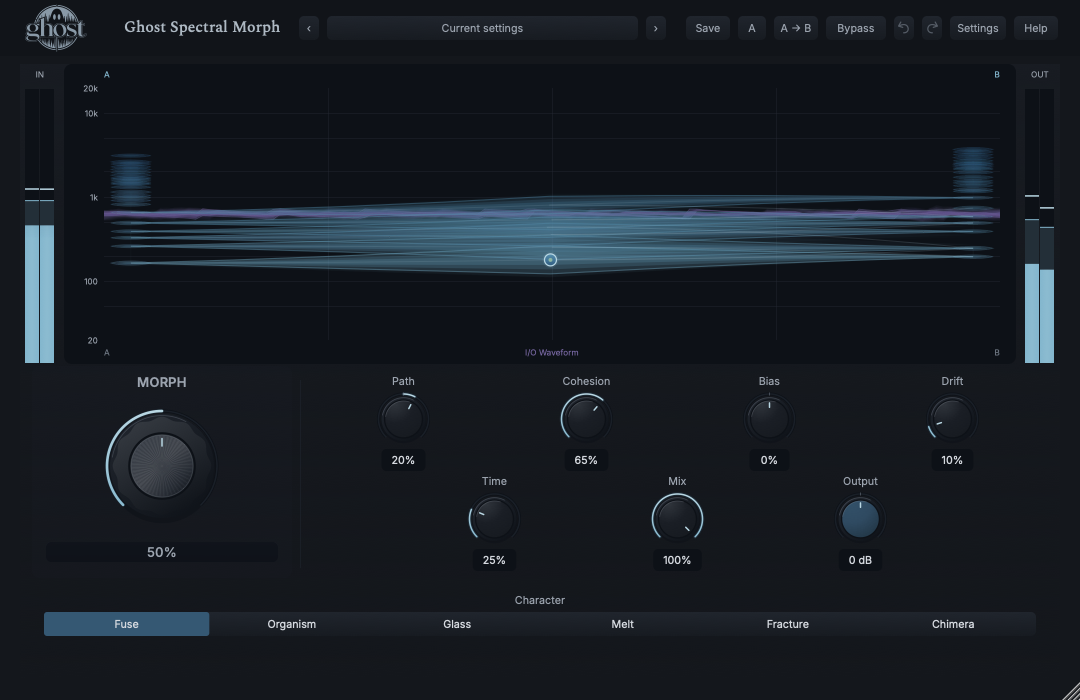
Blue spectral identities and correspondence paths transform between A and B in one field. The violet I/O waveform underneath supplies recent-time/amplitude context, not a second display or a frequency curve.
Choose a marker, or use the complete keyboard-accessible control reference above.
Frequency rises vertically; horizontal field position means transformation identity, not elapsed time. Missing input is explicitly indicated. Intermediate routes depend on actual source relationships.
Drag a path to Pull; fast release Throws. Shift-drag Breaks; Shift-Option onto a compatible structure Binds. Command-drag pushes local A/B identity; an empty-area swipe Disturbs nearby relationships.
Left/right selects; P Pulls, X Breaks, B Binds, A/D pushes A/B, Up/Down Throws and Space Disturbs. Right-click provides equivalents. Escape cancels; one gesture/Undo restores its physical baseline.
HEAR THE IDEA
Actual Fuse Morph at 50%, Path 20%, Cohesion 65% and Drift 10%. A is the original chord; B is the owned synthetic source at 1.5× source time with reversed stereo channels, supplied through the actual external bus. Source playback is A, not an invented blended reference.
Source
Source WAVProcessed · actual Ghost DSP
Processed WAV{"morph": 50, "path": 20, "cohesion": 65, "drift": 10, "mix": 100}. Actual native processor, stereo48k/127/double; source latency-aligned. Whole-file wet RMS gain 3.079796; common trim 1.0. Identical final20ms file fade; no listening approval inferred.
Reproduction recordPut a sustained instrument on Main A and a different vocal phrase on sidechain B.
Morph 50% · Cohesion 85% · Path 0% · Drift 0% · Mix 100%
Listen for: A live hybrid organized from both sources, not guaranteed semantic voice separation or a vocoder preset.
Use two sustained but distinct sources with both buses active.
Character Organism · Morph 55% · Path 35% · Cohesion 45% · Drift 30%
Listen for: Less exploratory variation after stabilization, not an audio capture of a permanently frozen hybrid.
GO DEEPER
Main is A; external sidechain is B. In Rack, A is the signal reaching this slot and B is the one shared external bus—not another slot's internal output. Missing B keeps A safe; connected silence can be a valid endpoint. A very short structural hold bridges gaps, not a sampler or long freeze.
Header A/B compares complete sound configurations under suite ownership. Field A/B names the two live inputs. Sessions retain analysis/short history and settings, but live playback still needs the DAW routes; portable sounds do not contain source audio or configure those routes.
Eight continuous controls support internal modulation and MIDI CC learn. Character is discrete host automation only. Shared orange cues show effective modulation separately from base values.
Mono/stereo Main and supported sidechain layouts are accepted. Time uses short source context and soft tempo landmarks, not a Sync mode, independent clock or time-stretch workstation.
Latency is reported and dry/Rack paths align. Panic clears wet running material without resetting controls. No Key/Scale, dedicated formant/envelope knobs, sample browser or long capture buffer is provided.
The preset browser offers All, Factory, User and Favorites, category/search filters and relevant Character filtering. A row's heart changes your personal favorites without loading or saving the sound. Save As creates a distinct User sound; explicit Save updates only the selected User sound. Factory content is protected. Name, category and tags support organization; deleting a User category keeps its presets as Uncategorized. Manage supports rename, duplicate, confirmed delete and individual/bulk/category import/export. Personal favorites stay on this installation rather than travelling in exported sounds.
Standalone and the matching Ghost Rack module share the same User sounds, categories and favorites. A module preset changes portable sound settings, not Rack placement, Rack wet/dry, bypass or modulation assignments. DAW recall embeds the sound settings and does not depend on a preset file remaining on disk. Rack chain presets are a different library and affect the whole chain.
Drag a knob normally, hold Shift for fine adjustment or Option for extra-fine. Double-click restores its default. Enter/context menus provide exact values, reset and value copy/paste; eligible controls also offer MIDI Learn and modulation. Tab and arrow keys provide keyboard access. A/B compares configurations; the adjacent copy button copies the active configuration to the other. Undo/Redo groups a continuous gesture into one edit. Settings provides UI scale, Reduced Motion, source configuration, portable settings and Panic. UI size/motion preferences do not change the sound.
WHEN SOMETHING ISN’T CLEAR
Verify a distinct live B is routed to the external sidechain and WAITING FOR B clears. Use Mix 100% and compare 0/50/100 before deep settings.
No. It describes transformation behavior; supply both live sources yourself.
The requested relationship must be plausible for the current sources. Expired or incompatible targets do not create arbitrary permanent connections.
It controls short temporal correspondence permission, not delay duration or a synced division.